
Paint residue disposal
On this page, we answer all questions about paint residue disposal. How do you do this safely and responsibly? And what is and isn't allowed? Can it go down the drain or in the residual waste container, for example? In most cases, paint residues fall under chemical and hazardous waste. This is also called KGA or KCA.
Due to the harmful chemicals and solvents that many paints contain, rules and regulations have been drawn up by the Dutch government. Thus, together we ensure that paint waste disposal and processing takes place with the least possible impact on humans, animals and the environment.
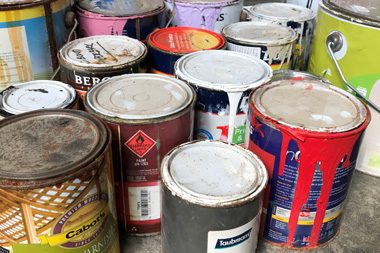
What to do with leftover paint?
You have painted your walls or window frames or hired a painter to do so. The job is done, but what can you do with the leftover paint? Of course, it can be useful to keep them. You can then use it later to touch up any damaged paintwork. Paint leftovers can be stored in a well-sealed tin or bucket, out of direct sunlight and at a cool temperature.
Are you not planning to use the leftover paint or is it very old paint? Then it is good to know that paint waste falls under small chemical waste. As a private individual, you can hand it in at your local council's recycling centre. In some places of residence this is called the waste depot, dump or waste transfer station. Special KCA containers, KGA boxes or chemical carts are available at these municipal waste depots for return old paint.
How to dispose of paint water?
Paint water contains harmful substances. So it is best to rinse used brushes and rollers in a bucket or empty paint can. You should not throw paint water down the sink or down the toilet. It will end up in the sewage system. In addition, paint residues and pigments can creep into your pipes and drains, with unpleasant consequences such as blockages. You can bring water with paint residues to your local council in a sealed bucket or can.
Can you flush paint down the sink?
No, it is very harmful to flush paint down the sink. It contains chemicals that are very harmful and should not go down the drain. Moreover, it is also very unwise to do because chemicals are corrosive substances that can break your pipes. Also, paint residue can accumulate in your sewer pipes resulting in blockages or leaks. So always take old paint to the waste disposal site.
Can turpentine go down the drain?
No, white spirit should not go down the drain. The same goes for other solvents, such as thinner. These are corrosive and also highly toxic substances that should not end up in the sewer. This is because they are difficult for the water board to filter. So it is forbidden to flush turpentine residues down the sink. Moreover, it is also not a smart thing to do, as you can severely damage your pipes by doing so.
Where to dispose of paint brushes?
You can dispose of used paint brushes in special KCA containers at your local council. Private individuals can often go to the environmental street 6 days a week to hand in old brushes, wall paint rollers and paint cans free of charge. This way, you contribute to a better environment.
Can paint go with residual waste?
Paint falls under small chemical waste, also known as small hazardous waste (MSW or KCA). In most cases, this means that it should not be thrown away with residual waste. This is because almost all types of paint contain chemical, toxic and environmentally polluting substances. It should therefore be separated from household waste so that it can be disposed of responsibly and safely.
Only 100% dried water-based paint or completely empty paint cans or paint buckets should go in the residual waste container.
How do you dispose of old paint?
The maxim is to dispose of old paint in the special containers at your municipality's environmental centre, waste point or waste transfer station. You can dispose of it there free of charge in the chemokar, KGA box or KCA container. This is because paint is chemical waste and contains toxic and environmentally polluting substances. It should therefore not be disposed of with residual waste, as this is bad for the environment.
Are you a painter or run a painting business? There are a number of rules for paint disposal business. Contact us for the possibilities. We are happy to serve you with our KCA Collection Service for companies.
Where do you leave paint waste?
You should take paint waste away to the municipality's waste depot. In most cases, this is free of charge. Paint waste includes all paint (residues), such as stain, wall paint, lacquer and component paint. Both in liquid or solid/dry form, water/alkyd/acrylic-based or turpentine-based. (Chemical) paint waste also includes brushes, rollers, paint tools, thinner, white spirit and other solvents. It should not be disposed of with residual waste or down the drain.
What to do with leftover wall paint?
Have you painted your walls and have leftover wall paint? It is handy to keep these leftovers in a well-sealed tin or bucket. Then you can use it in the future in case of damage. Make sure it is not in direct sunlight and cannot get too hot or cold. Usually in a cellar or shed is a good place to store it.
Do you want to throw away leftover wall paint? Then think of the environment and take it to your local council's waste centre. If it is water-based paint and has dried completely, it may be disposed of with residual waste. Otherwise, it falls under the category of small chemical waste and should be disposed of separately.
What do you do with empty paint cans?
Old or empty paint cans are best disposed of in the special chemical waste containers at the municipality. In principle, you can put a single empty paint can in your residual waste container, but if you want to dispose of larger quantities or (semi-)liquid paint residues, you can go to the environmental street. A small effort and much better for the environment!
Business disposing of paint residues?
Please contact us for current prices for disposal of business paint residues and accessories. Our specialists will be happy to provide you with a competitive, no-obligation proposal.